Interstellar spectacle / IMAGINED 1970s
The Space-Time War
All of space. All of time. One family argument.
 By Benjamin FosterA speculative close reading · 2 min read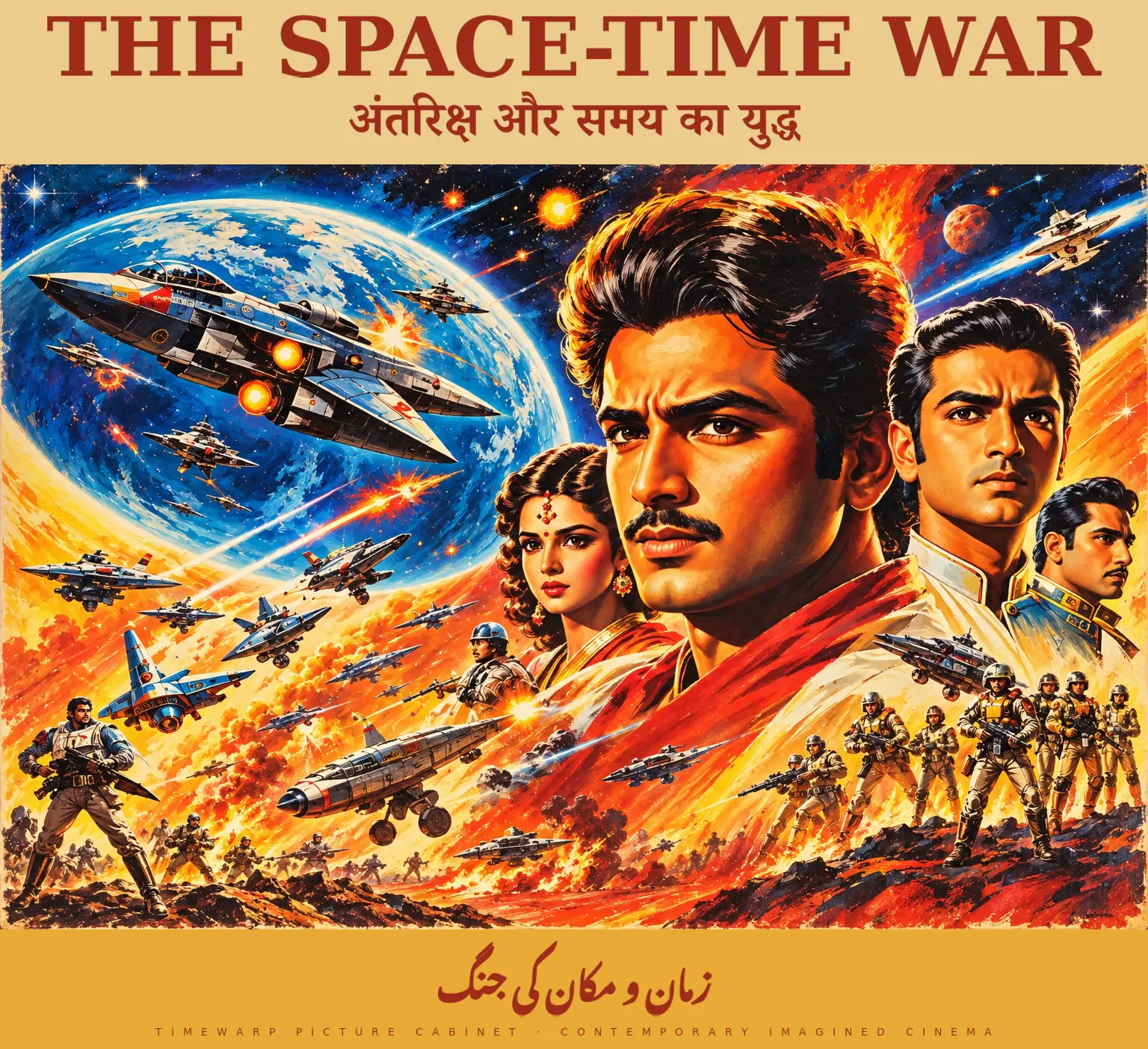
The Space-Time War promises the end of the universe. It delivers something more troubling: the realisation that the enemy has a perfectly reasonable mother.
The galaxy is a crowded household
By the time the first spacecraft crosses the screen, three rival houses have laid claim to the same planet and a fourth has objected to the seating arrangements. The Space-Time War understands scale. It also understands that scale is useless without someone taking a slight personally.
In our imagined epic, a signal from the future has convinced two worlds that each must strike first. Both possess impeccable proof. Both have neglected to ask who sent the signal. Captain Dev is dispatched to restore order and immediately encounters Tara, whose orders are identical and whose uniform is considerably better.
An interval large enough to park a fleet
This is a future of sumptuous excess. Ships have balconies. Admirals enter under their own lighting cues. Somewhere in the engine room, a man in a spotless white suit assures everyone that the impossible can be achieved, provided nobody touches the red lever. Naturally, there are six red levers.
Yet the film’s imagined centre is quiet: Dev and Tara listening to the same message through different receivers. What one hears as a threat, the other hears as a plea. Their alliance begins not with an embrace but with the radical decision to replay the evidence.
A ceasefire in another key
The final confrontation does not turn on superior firepower. It turns on a transmission stripped of its terrifying accompaniment. The message from tomorrow is not an order to attack. It is the distorted echo of everyone begging everyone else to stop.
The fleets fall silent. Then, inevitably, the orchestra returns. A universe saved by listening deserves a musical ending. Whether the families can agree on the wedding arrangements is a problem even time travel wisely declines to solve.
New speculative essay based on an original-site film concept and generated poster. No real cast, studio, battle or release history is asserted.
How to read the Timewarp ↗